
- 拡大
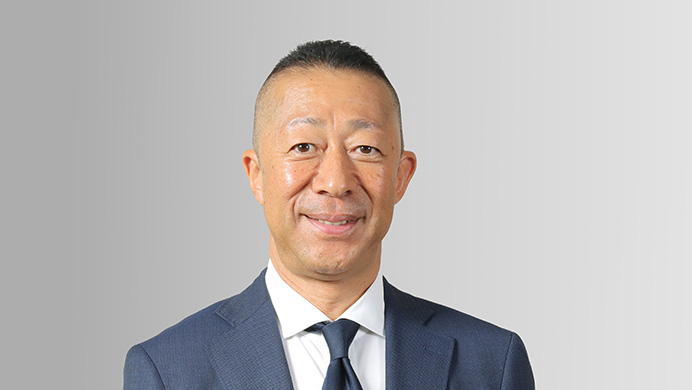
- Junya Kiyota, President and Chief Executive Officer
I am Junya Kiyota. I was appointed President and Executive Officer as of July 1, 2026, and assumed the position of Representative Director following resolutions adopted at the Ordinary General Meeting of Shareholders and the Board of Directors meeting held on September 29 of the same year. As I take the helm of management, I respectfully ask for the continued guidance and encouragement of our shareholders.
Since joining the Company in 1989, I have built my career primarily in research and development, and in recent years have served as General Manager of the Institute of Advanced Technology, General Manager of the Development Division, and General Manager of the Components Business Division. Succeeding former Chairman Iwashita, who devoted himself to the development as the Group's top executive over the past nine years, I will dedicate myself fully to further enhancing corporate and social value and achieving sustainable growth.
Orders reached a record high, driven by the expansion of generative AI, while profit declined due to temporary factors.
In the fiscal year ended June 2026, when we formulated and launched our mid- to long-term management plan, the Value Up Plan, orders and net sales increased as the semiconductor-related market expanded against the backdrop of the rapid adoption of generative AI. Profit, however, declined year on year due in part to the recording of temporary expenses.
Orders increased substantially for semiconductor production equipment, display production equipment, and industrial equipment, including rare-earth-related businesses, reaching a record high of ¥324.2 billion, up 43.7% year on year.
Although sales of semiconductor and electronic device production equipment decreased due to a reactionary decline in power device investment in Japan and China, sales of display production equipment increased as a result of capital investment associated with larger OLED substrates and modification projects. Components, industrial equipment, and materials also remained firm. Consequently, net sales exceeded the initial forecast and reached ¥269.1 billion, up 7.1% year on year.
Profit was affected by temporary factors, including EV-related expenses such as provisions for doubtful accounts and additional costs, as well as the deferral of sales from certain large-scale semiconductor production equipment projects. As a result, operating profit was ¥19.6 billion, down 26.1% year on year; ordinary profit was ¥19.9 billion, down 30.4%; and profit attributable to owners of parent was ¥17.1 billion, up 2.4%. The operating profit margin declined from 10.6% to 7.3%, while ROE declined from 7.5% to 7.4% due to an increase in shareholders’ equity.
After conducting a comprehensive review of the plan, we will decisively implement the necessary reforms and build the foundations for future growth.
The Value Up Plan is a six-year initiative designed to accelerate the shift toward a business portfolio centered on the semiconductor and electronics fields. By the end of the plan’s second year, the fiscal year ending June 2027, we aim to complete business reforms and optimize management resources, while enhancing the growth potential and profitability of the entire Group through growth strategies and production reforms. For the plan’s final year, the fiscal year ending June 2031, we have set the following financial targets: net sales of ¥360.0 billion, of which at least 60%, or ¥216.0 billion, will come from the semiconductor and electronics fields; operating profit of ¥79.0 billion, representing an operating profit margin of 22%; and ROE of 16%.
Meanwhile, the environment surrounding the Group’s businesses has continued to change since the Value Up Plan was formulated in August 2025, with AI- and data-center-related businesses expanding at a particularly faster pace than anticipated. Going forward, we intend to concentrate resources in these businesses, build a track record, capture the market from every angle, and achieve strategic growth.
In the first year of the plan, the fiscal year ended June 2026, orders reached a record high as described above. In semiconductor production equipment, we achieved results that significantly outpaced the growth of the overall market. Regarding business reforms, we made progress in reviewing the display production equipment business and restructuring low-profit businesses. In production reforms, concrete benefits have begun to emerge, including a 20% reduction in design man-hours through the promotion of modular design and approximately ¥1.0 billion in variable cost reductions.
At the same time, the fiscal year ended June 2026 once again highlighted the challenges facing the Group. Despite a substantial increase in orders, growth in net sales and profit remained limited. We believe the main reasons were the materialization of parts supply risks and the fact that efforts to shorten manufacturing lead times remain incomplete, in other words, production constraints. Unless we can reliably convert the orders we have secured into sales and profit, it will be difficult to achieve the improvements in growth potential and profitability envisioned under the Value Up Plan.
Based on this recognition, in the fiscal year ending June 2027, we will conduct a comprehensive review of the Value Up Plan, decisively implement the necessary reforms, and promptly establish the foundations for growth from the fiscal year ending June 2028 onward.
Under our growth strategy, we will define the AI and data center market as a strategic theme. To capture growth opportunities across the market, we will identify the Group’s strengths and concentrate management resources in priority areas. By increasing the proportion of advanced, high-value-added projects, we will pursue both high growth and high profitability.
In business reforms, we advanced initiatives during the fiscal year ended June 2026, including business divestitures and downsizing, as well as the restructuring of production sites. However, as the resulting improvement in profitability was limited, we will further accelerate reforms under the new management team.
During the fiscal year ending June 2027, we will complete the downsizing or withdrawal from low-profit businesses while also reviewing head-office functions, the fixed-cost structure, and the business portfolio.
In production reform, our most important priority, we will revise our supplier strategy and shorten procurement lead times for parts, while consolidating and automating logistics warehouses at each site to improve logistics efficiency. To expand production capacity, we will also consider investment to enhance the Kyushu Plant, a key manufacturing site for semiconductor- and electronics-related products. For rare-earth-related products, we plan to commence production at the Chigasaki Plant.
Although net sales are expected to decline due to the impact of business reforms, we forecast higher profit as the proportion of high-margin projects increases.
For the fiscal year ending June 2027, orders are expected to decrease from the substantially higher level recorded in the fiscal year ended June 2026, reflecting the impact of business reforms and a reactionary decline in display production equipment. Even so, orders for semiconductor production equipment are expected to remain at a high level.
Net sales are also expected to decline due to the implementation of business reforms and a reactionary decline in display production equipment. However, we anticipate that the sales mix will improve as high-margin semiconductor- and rare-earth-related projects account for a greater share of sales.
Regarding operating profit, although profit will be reduced by business divestitures and other factors, the temporary factors that caused the decline in the fiscal year ended June 2026 will be eliminated, and the increase in the high-margin projects described above is expected to contribute to profit growth.
Based on these assumptions, for the fiscal year ending June 2027 we forecast consolidated orders of ¥260.0 billion, down 19.8% year on year; net sales of ¥255.0 billion, down 5.3%; operating profit of ¥28.0 billion, up 42.9%; ordinary profit of ¥28.0 billion, up 40.6%; and profit attributable to owners of parent of ¥19.0 billion, up 11.2%.
We will build a robust foundation, firmly capture growth in the AI and data center market, and enhance profitability.
Our basic policy on shareholder returns is to pay performance-linked dividends with a target payout ratio of at least 35%.
For the fiscal year ended June 2026, in light of the decline in profit and from the standpoint of emphasizing shareholder returns, we paid a year-end dividend of ¥152 per share, down ¥12 year on year, for a payout ratio of 43.8%. For the fiscal year ending June 2027, we plan to pay a year-end dividend of ¥152 per share, for a payout ratio of 39.4%.
The new management team is firmly committed to executing the Value Up Plan and achieving its financial targets. In the fiscal year ending June 2027, we will thoroughly implement business and production reforms and build a robust foundation to support future growth. On this solid foundation, we will maximize the Group’s technological advantages, firmly capture growth in the AI and data center market, and enhance profitability.
We respectfully ask our shareholders to look forward to ULVAC’s leap toward the future and to continue supporting us over the long term.
Sept. 2026